
Quantum computing is emerging from theory into a new industry that investors and technology observers are watching closely. In 2024, global funding for quantum startups reached record highs. Governments are also preparing for a quantum-first future with the U.S. National Quantum Initiative Act and the National Institute of Standards and Technology (NIST) introducing new cryptographic standards resistant to quantum attacks. But why all the buzz about a technology still in its early stages?
To understand the impact of quantum computing on the world, you must understand the foundational concepts of quantum computing and the hardware.
Quantum Mechanics Basics: Superposition, Entanglement, and Measurement
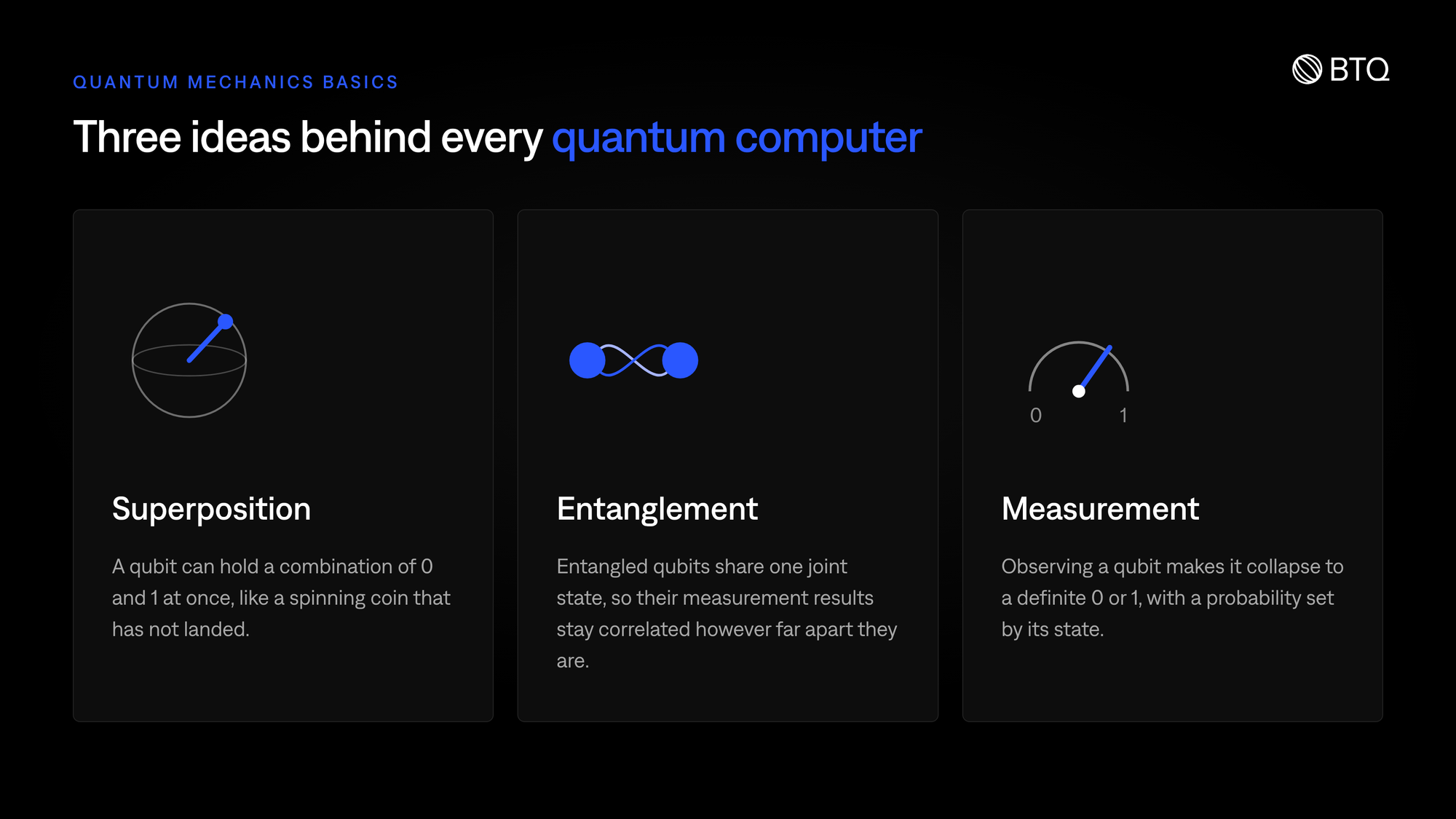
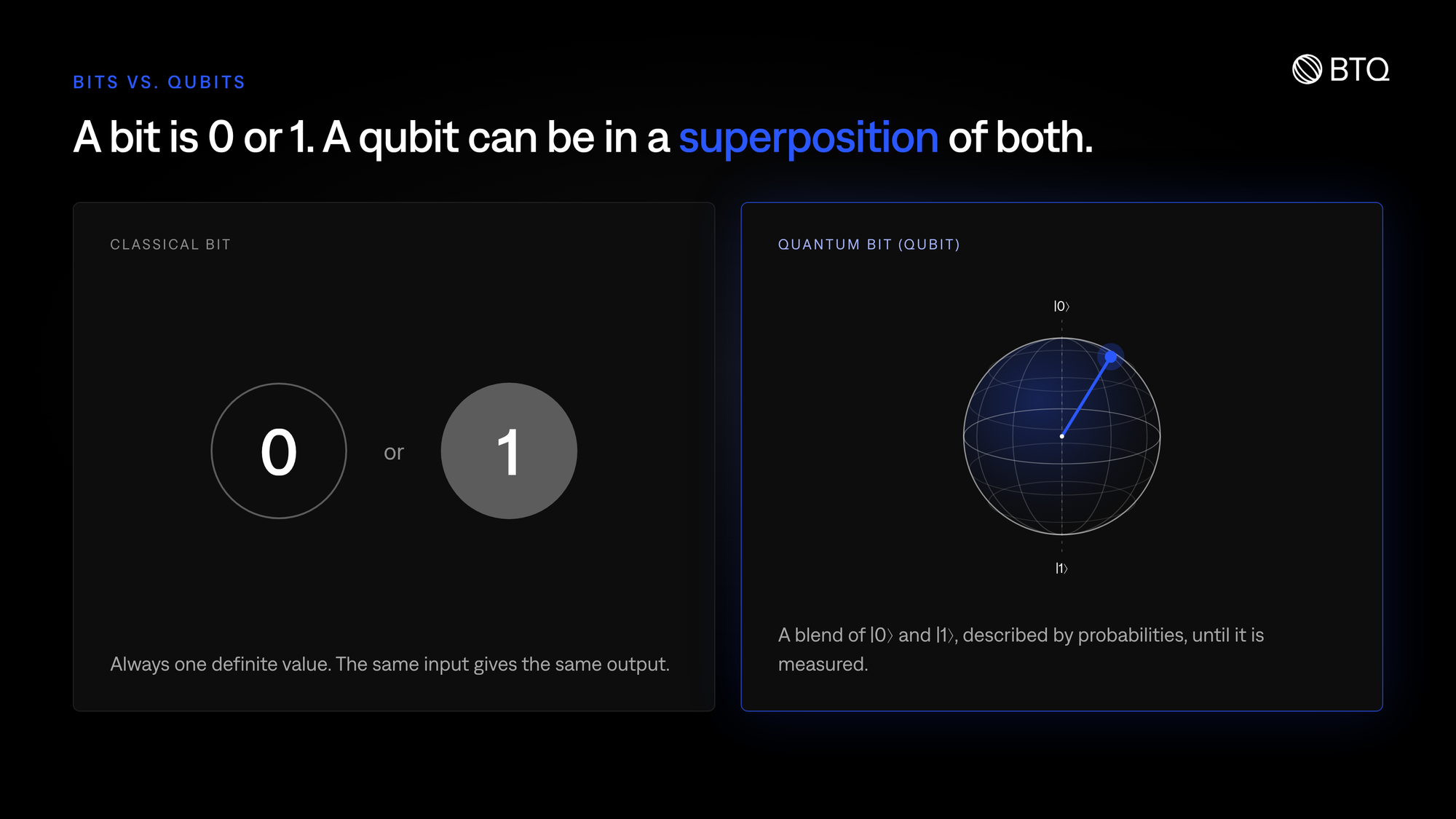
Quantum computers derive their power from principles of quantum mechanics that differ radically from classical physics. Superposition is one key concept: whereas a classical bit is either 0 or 1, a quantum bit (qubit) can exist in a combination of 0 and 1 at the same time. The qubit’s state is a blend of the two basis states (|0⟩ and |1⟩) until we observe it. This is often compared to a coin spinning in the air, not showing heads or tails until it lands, except that a qubit’s “spin” is a genuine simultaneous existence in both states, described by probability.
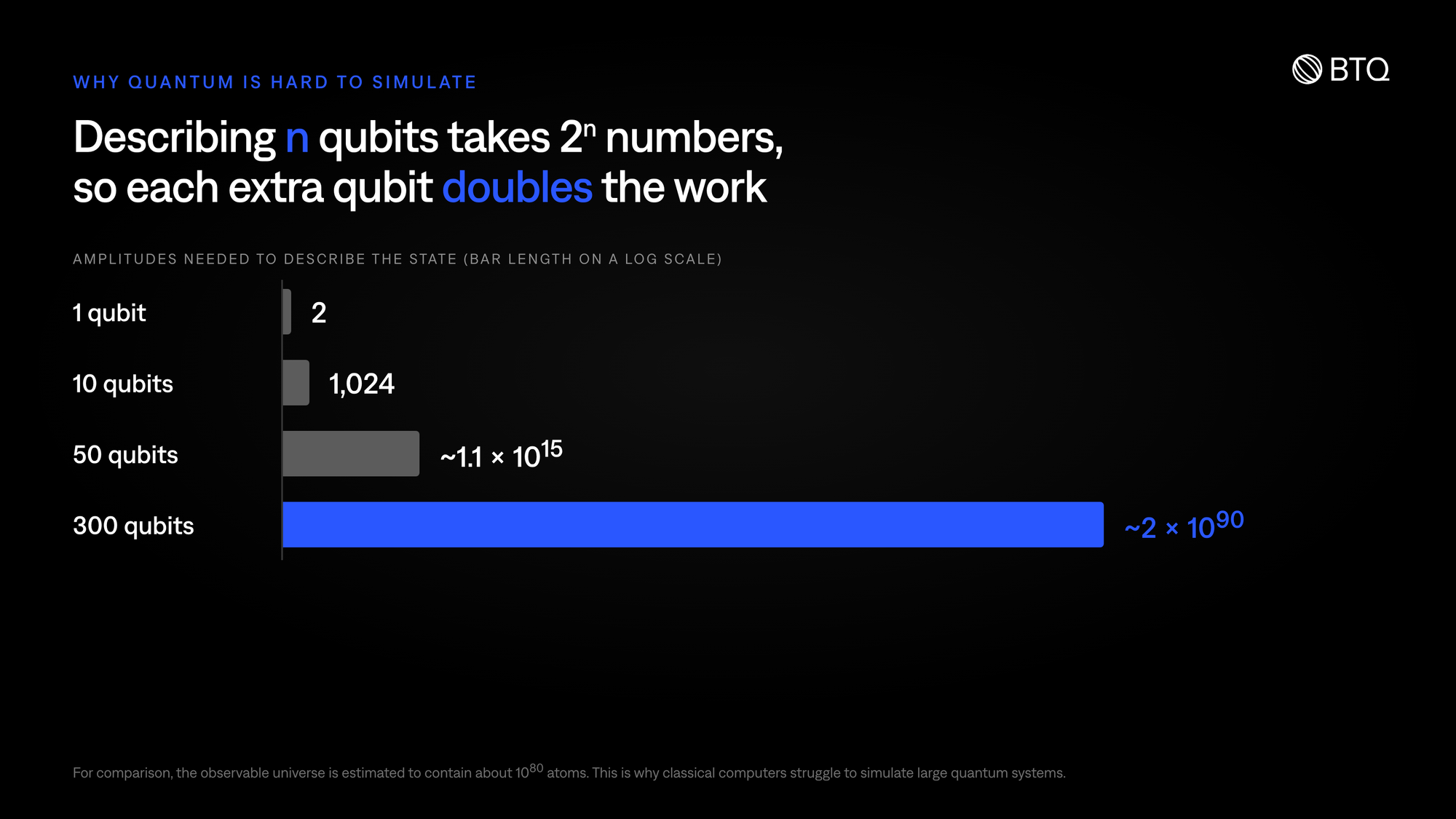
Entanglement is another crucial concept in quantum computing. When two qubits become entangled, they share a joint state, meaning you cannot describe the state of one without the state of the other. An entangled pair can exhibit strong correlations: measuring one qubit instantly influences the state of its partner, no matter how far apart they are. Einstein famously called this “spooky action at a distance,” and it allows quantum computers to link qubits in ways impossible for classical bits. This inseparability is what gives quantum systems computational power. The amount of calculations that n qubits can do grows exponentially (proportional to 2^n) because of entanglement, making it extraordinarily complex for classical computers to simulate large quantum systems.
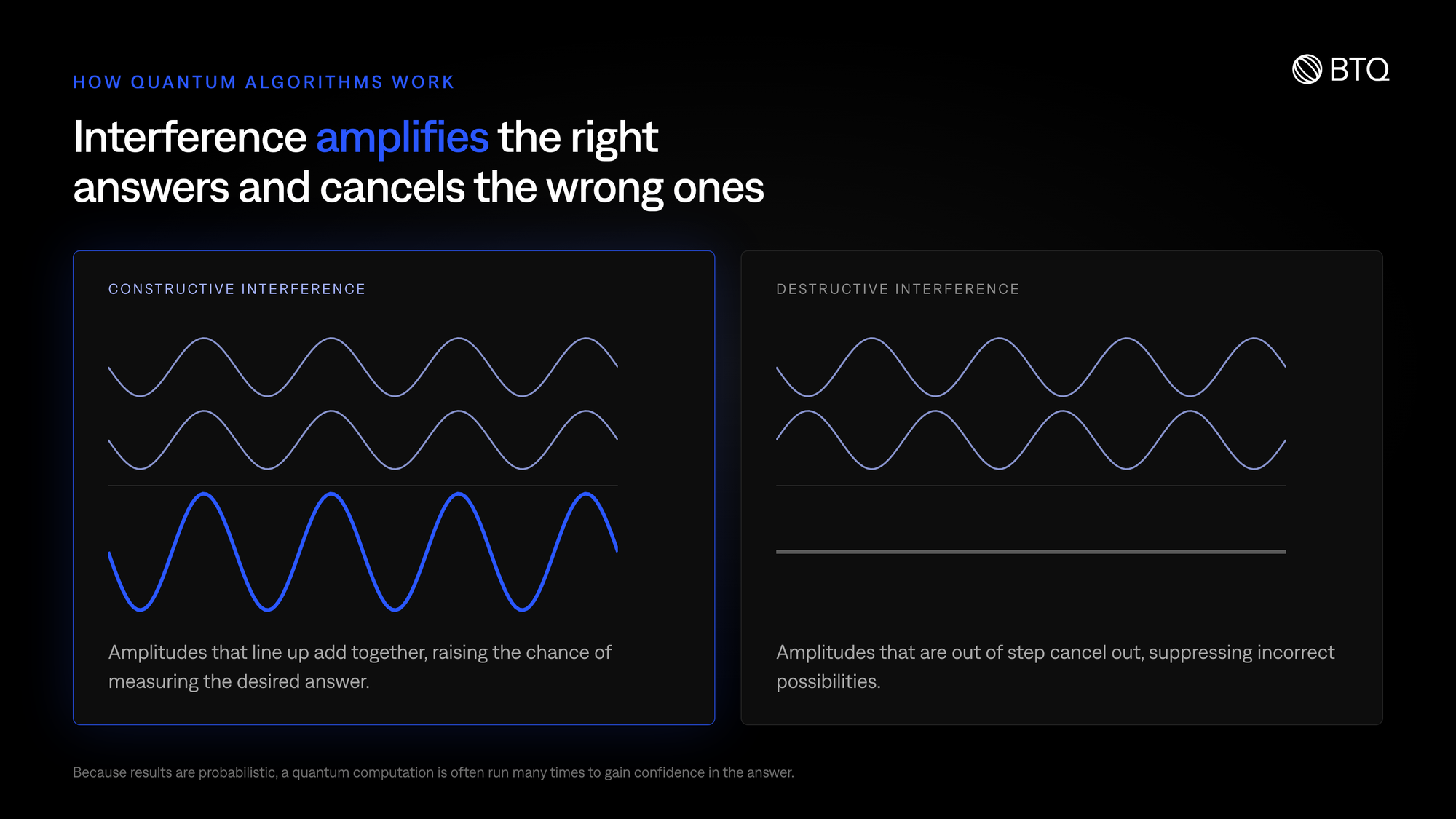
However, quantum magic disappears once a measurement is made. This forces the qubit to “collapse” to a definite value (0 or 1). If a qubit were in an equal superposition of 0 and 1, neither outcome is certain until observed – the best we can say is there was a 50% chance of each. This inherent randomness is a fundamental difference from classical bits. Quantum algorithms, therefore, must be designed to use interference before measurement: by choreographing qubit interactions, constructive interference can amplify the probability of measuring correct or desired answers, while destructive interference cancels out the incorrect possibilities. The combination of superposition and entanglement allows a quantum computer to process information in ways a classical computer cannot, but the probabilistic nature means we often run quantum computations multiple times to gain confidence in the result.
Bits vs. Qubits: Quantum Computing’s Computational Power
The motivation for quantum computing is that some problems appear to be vastly more efficient to solve with qubits than with bits. In theory, a classical computer can solve any problem a quantum computer can, given unlimited time and memory. Quantum computing doesn’t expand what’s computable, but it can drastically reduce the time complexity for certain tasks.
For example, Peter Shor discovered that a quantum algorithm could factor large numbers exponentially faster than any known classical method. Factoring is the hard mathematical problem underlying RSA encryption; Shor’s algorithm showed that a sufficiently advanced quantum computer could break RSA by factoring its large key numbers in a feasible time, something classical computers cannot do in the age of the universe. Quantum algorithms exploit the massive parallelism of superposition and the interference of amplitudes to leap ahead of classical performance on specific problems.
Classical algorithms are typically deterministic; the same input produces the same output through a well-defined sequence of logical operations (unless randomness is explicitly introduced). Quantum algorithms, on the other hand, often have probabilistic outputs due to measurement collapse. The outcome of a quantum computation might be correct only with a certain probability, but by designing the algorithm cleverly (using interference as noted above), that probability can be made very high. In practice, a quantum computation may be run many times to statistically verify an answer. This probabilistic nature is not necessarily a drawback; rather, it’s a trade-off that comes with the ability to explore a vast computational space simultaneously.
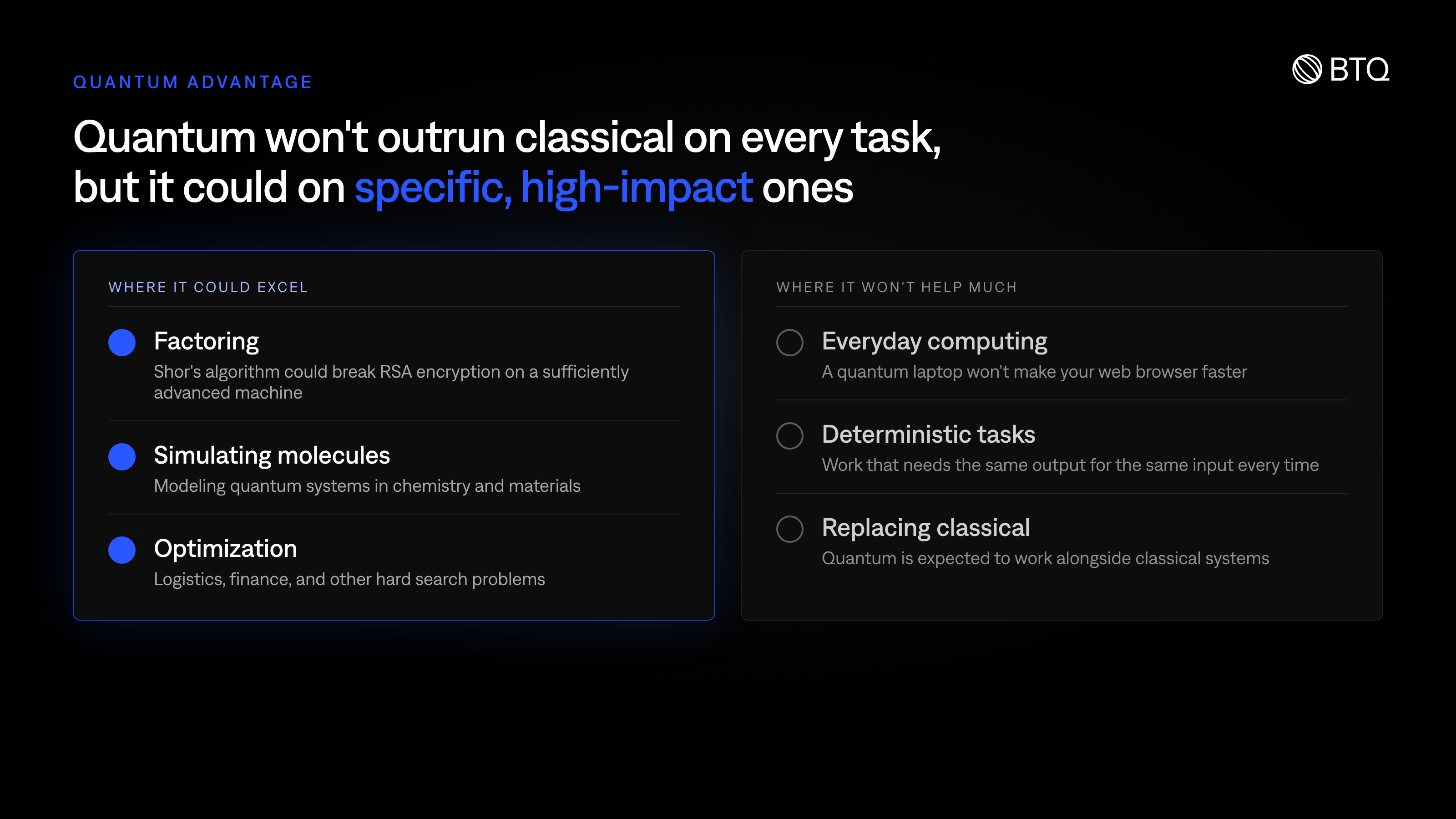
Quantum computers won’t outrun classical ones on every task. They excel in certain domains (like factorization, quantum system simulation, optimization problems), but a quantum laptop won’t necessarily make your web browser run faster. The true promise lies in tackling problems that are intractable for classical machines. The terms quantum supremacy and quantum advantage arose, referring to a quantum computer performing a task that no classical computer could realistically achieve. In 2019, Google’s research team made headlines by claiming such a supremacy experiment (a quantum processor solved a contrived sampling problem faster than a supercomputer could). This was a landmark, but not yet a practical and useful application.
What’s Next for Practical Quantum Computing
Quantum computing holds enormous promise, but it’s not ready to take over yet. Today’s machines are early prototypes. These systems typically have dozens to a few hundred qubits, which are enough to run small-scale experiments, but not enough for fault-tolerant, large-scale computing.
To reach that next level, quantum hardware and software must overcome four key challenges:
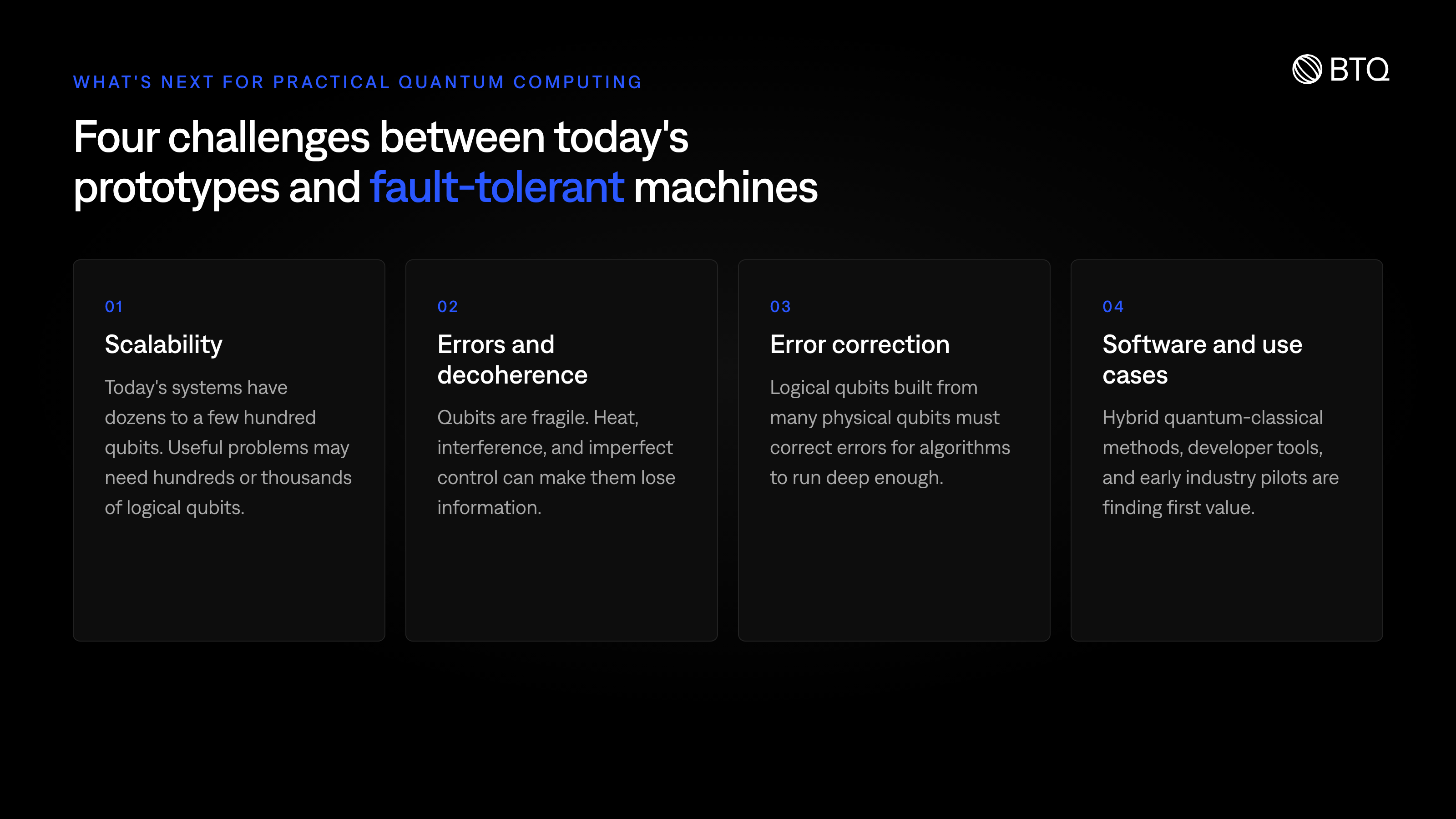
Scalability: Current systems max out in the low hundreds of qubits. But solving real-world problems may require hundreds or thousands of logical qubits. Because of noise, each logical qubit may require thousands of physical qubits. That means we’re still orders of magnitude away from practical systems. Progress is happening: some platforms, like neutral atoms and photonics, are pushing toward 1,000+ qubit arrays, but quality matters more than quantity.
Error rates and decoherence: Qubits are fragile. Temperature shifts, electromagnetic interference, or imperfect control can cause them to lose information, a process called decoherence. Gate operations can also introduce small errors that compound over time. Every hardware platform, whether superconducting, ion-based, or optical, faces different trade-offs in error rates and scalability. Improving fidelity and extending coherence time are top priorities for all players in the space.
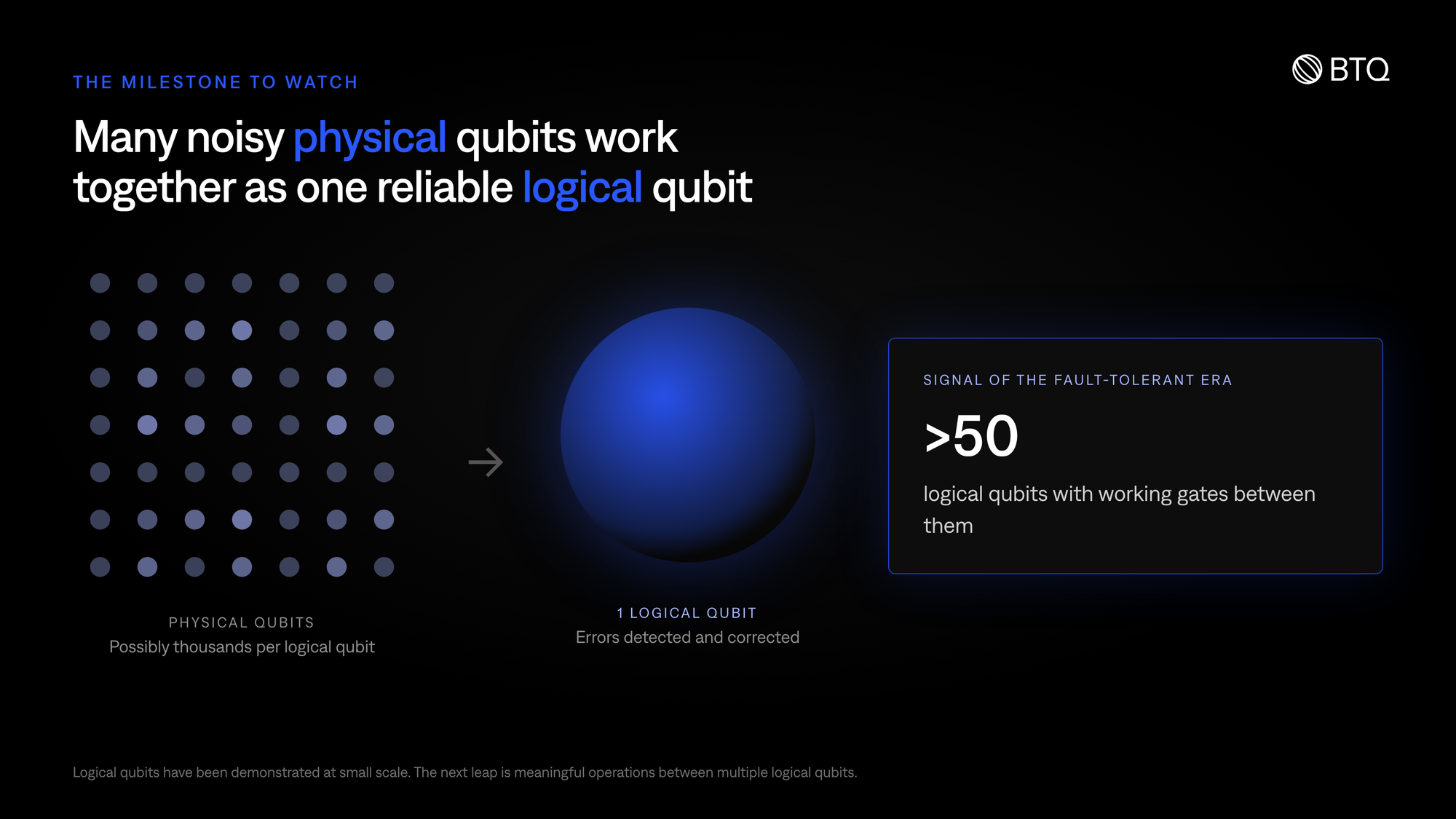
Error correction: Without robust quantum error correction, algorithms can’t run deep enough to be useful. A key milestone to watch is the scaling of the logical qubits, which are made of many physical qubits that work together to correct errors. That’s already been demonstrated at a small scale. The next leap is performing meaningful operations between multiple logical qubits. If we see systems with >50 logical qubits and functioning gates between them, that’s a signal that the fault-tolerant era is approaching.
Software and use cases: Even with limited hardware, there’s work to be done. Smarter quantum algorithms and hybrid models (where quantum and classical systems collaborate) are emerging to extract value from NISQ-era machines. Software stacks, developer tools, and cloud access are evolving. Early industry partnerships in fields like chemistry, logistics, and finance are stress-testing where these machines might first deliver a competitive edge.
When Will We See Real Impact?
Predictions vary, but most experts believe we’ll see problem-specific quantum advantage, meaning a quantum machine outperforms the best classical approach, within 5 years. Some argue it’s already here, with companies using quantum computing in production. Still, quantum computing is in the "pre-iPhone" phase: technically possible, not yet scaled. But the breakthroughs are stacking up. And when progress happens, it can be nonlinear.
The value in this sector won’t come from waiting until everything works perfectly. It will come from understanding which technologies are maturing, which business models can scale, and which partnerships are turning R&D into real advantage.
Quantum won’t replace classical computing. But for specific, high-impact tasks, cracking encryption, simulating molecules, and optimizing systems, it might be the only tool that works to unlock a new era in that industry.